
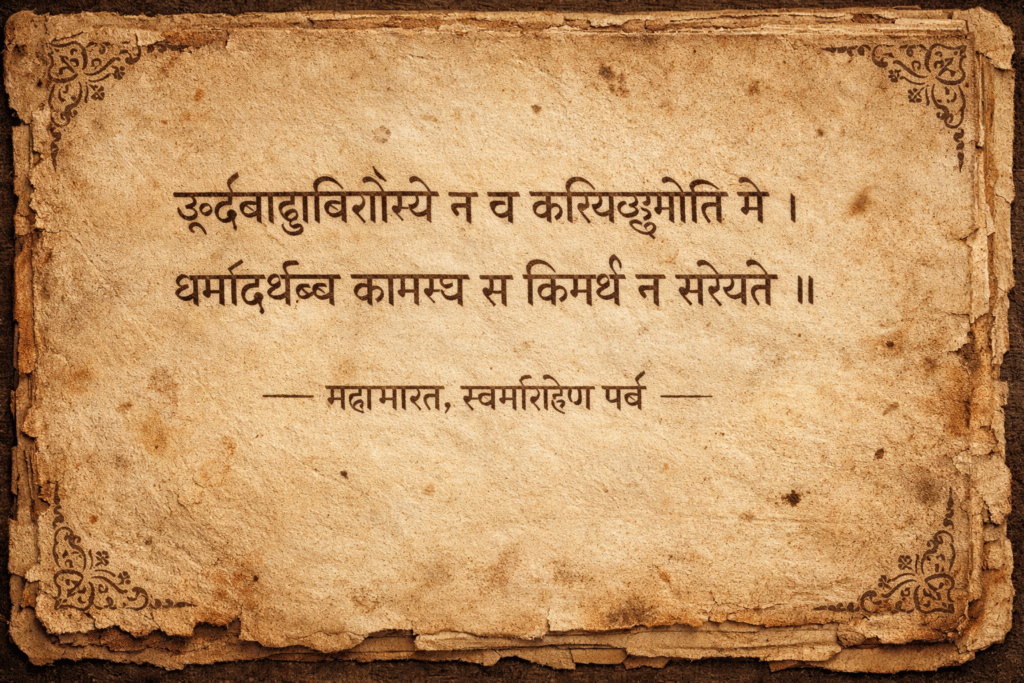
“ऊर्ध्वबाहुर्विरौम्येष न च कश्चिच्छृणोति मे ।
धर्मादर्थश्च कामश्च स किमर्थं न सेव्यते ॥”
— Mahabharata, Swargarohan Parva
Imagine a senior mentor. Decades of experience. He has seen businesses built from scratch, families split over control, fortunes created and lost. He raises both hands and says, “Listen carefully.” And yet, no one listens.
That is the frustration and emotion behind this powerful verse. The message is simple and straightforward: If Wealth (Arth) and Ambition (Kama) ultimately depend on Dharma, why do people ignore Dharma?
For Business Owners and HR Professionals working with Family driven companies , this is not Spiritual Theory. It is practical strategy.
Ancient Indian wisdom spoke about three drivers the real Business Success Triangle:
- Dharma – Ethics, responsibility, long-term thinking
- Artha – Wealth, profitability, financial stability
- Kama – Ambition, aspiration, growth
Most businesses start with Artha and Kama. Revenue targets. Expansion plans. Bigger facilities. Higher valuations. Dharma often enters the conversation later, usually after a crisis.
But the verse flips the order. It says Artha and Kama stand on Dharma. If the foundation is weak, growth becomes temporary.
Dharma is not about being soft. It is about being principled and structured. We translate Dharma into two practical lenses, essentially 3CX3P matrix.
3Cs Alignment
- Competency – Are capable people placed in roles based on merit?
- Compliance – Are legal, financial and ethical standards clearly followed?
- Culture – Is trust built intentionally through transparency and fairness?
When these three align, risk reduces and profitability becomes more stable.
The 3P Framework: Making Dharma Operational
To make this actionable for founders and HR leaders, we use the 3P framework.
- People – Do we have clear job descriptions and performance metrics? Are we investing in skill development? Is succession planning documented? Strong businesses build leaders, not dependencies.
- Purpose – Does the team know why the business exists beyond profit? Is there alignment between family vision and organizational goals? Are values clearly defined and communicated? Purpose builds commitment. Committed teams outperform managed teams.
- Process – Are key decisions system-driven or personality-driven? Do we have SOPs for operations and HR? Can the business run smoothly even if one leader steps away? Process creates continuity. Continuity creates stability.
Practical Takeaways for Founders and HR Leaders
- Document governance policies before conflict forces you to.
- Build a simple but clear performance management system.
- Separate family roles from business roles formally.
- Conduct periodic culture audits, not just financial audits.
- Invest in leadership development early, not after attrition rises.
Markets are competitive. Regulations are tightening. Talent expectations are changing. Weak foundations get exposed faster than ever.
In the Real Businesses scenario, we repeatedly see three patterns.
- Growth Without Governance: Sales increase. Operations expand. But compliance is informal. Decision-making is centralized. Documentation is weak. It works while the founder is present. It struggles when complexity increases. The issue is not lack of effort. It is lack of structure.
- HR Reduced to Administration: Many growing businesses treat HR as payroll processing and attendance tracking. There is no performance framework, no leadership pipeline, no succession planning. When margins tighten, employee costs are the first to be cut. People are not a cost line. They are a growth multiplier. But here is the hidden cost:
- Burnout lowers productivity
- High attrition increases hiring expenses
- Low engagement affects customer experience
When People, Purpose and Process are aligned, Dharma becomes visible. And when Dharma is visible, Artha becomes sustainable and Kama becomes disciplined ambition rather than reckless expansion.
The Real Question
Is your growth structured or accidental? Is your culture intentional or inherited? Is your HR strategic or clerical?
The ancient voice from the Mahabharata still feels relevant because business realities have not changed. Only the scale has.
If this resonates, it may be time to realign your business around People, Purpose and Process.
At BusinessNiti, we work with MSMEs and family enterprises to design governance systems, ethical HR structures and sustainable growth blueprints.
Stay Connected with www.BusinessNit.in