
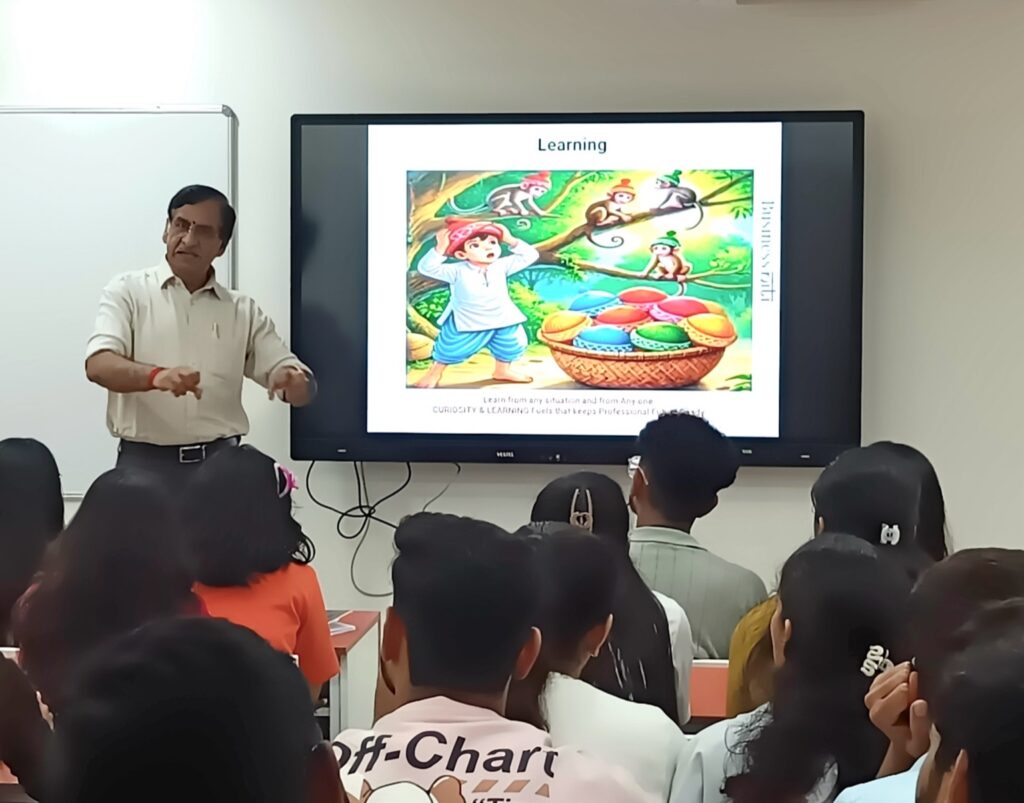
I recently had the privilege of taking a session on Future Readiness with the management students of #JGUniversity. Instead of diving into heavy theories or complex frameworks, I chose a path closer to our roots—learning management through #timelessIndianStories.
Why stories? Because they stay with us longer than models or formulas. They are easy to remember, and more importantly, they help us see how values and strategies play out in real life. Our traditional tales carry rich lessons on #adaptability, #collaboration, #ethics, #continuouslearning, and #humanbehavior skills every future manager needs.
One such story we discussed was the well-known tale of the Monkey and the Cap Seller. The tale is not just an amusing anecdote; it carries deeper insights that resonate with the core of management principles in today’s fast-paced world.
A cap seller once fell asleep under a tree with his basket of caps. When he woke, monkeys were on the branches, each wearing a cap. Frustrated but clever, he threw his own cap on the ground. The monkeys copied him, and he collected his caps, illustrating the importance of understanding behavior and adaptability in situations we encounter.
However, this story expands beyond mere surface-level interpretation. It serves as a reminder of generational learning and the importance of innovation. Years later, when his grandson tried the same trick, the monkeys refused. One monkey said, “Do you think we are foolish? Just as you learn from your ancestors, we too have learned from ours.” This twist reminds us: the future belongs not to the strongest, but to the most adaptive. The future belongs to learners, not knowers, and in a changing world, wisdom is not in repeating the past but in adapting for the future.
This lesson encourages us to foster a culture of learning and innovation where ideas are not just inherited but also critically examined and evolved. In the context of management, it emphasizes the need for continuous adaptation, where leaders must be open to feedback and willing to change strategies based on new insights and changing environments. For example, in today’s digital age, where technologies are constantly evolving, managers must be prepared to adopt new tools and methods, harness data analytics, and engage with their teams in ways that encourage collaboration and creativity.
As we delve deeper into this narrative, we uncover the necessity of embracing change and the role of leadership in guiding teams through transitions. Leaders who can effectively communicate their vision and inspire their teams to embrace change will be the ones paving the way for success in their organizations. They must also promote resilience among team members, equipping them with skills to face uncertainties and challenges effectively.
Ultimately, the tale of the Monkey and the Cap Seller serves as an impactful metaphor for the journey towards future readiness, offering insights that are relevant not only to management students but to anyone striving to thrive in an ever-evolving landscape. By embracing the lessons from such timeless stories, we can prepare ourselves and our teams to navigate the complexities of the future with confidence and agility.